Aliganj records highest particulate pollution, while Vikas Nagar registers peak noise level of 90.3 decibels; researchers recommend stricter green cracker enforcement
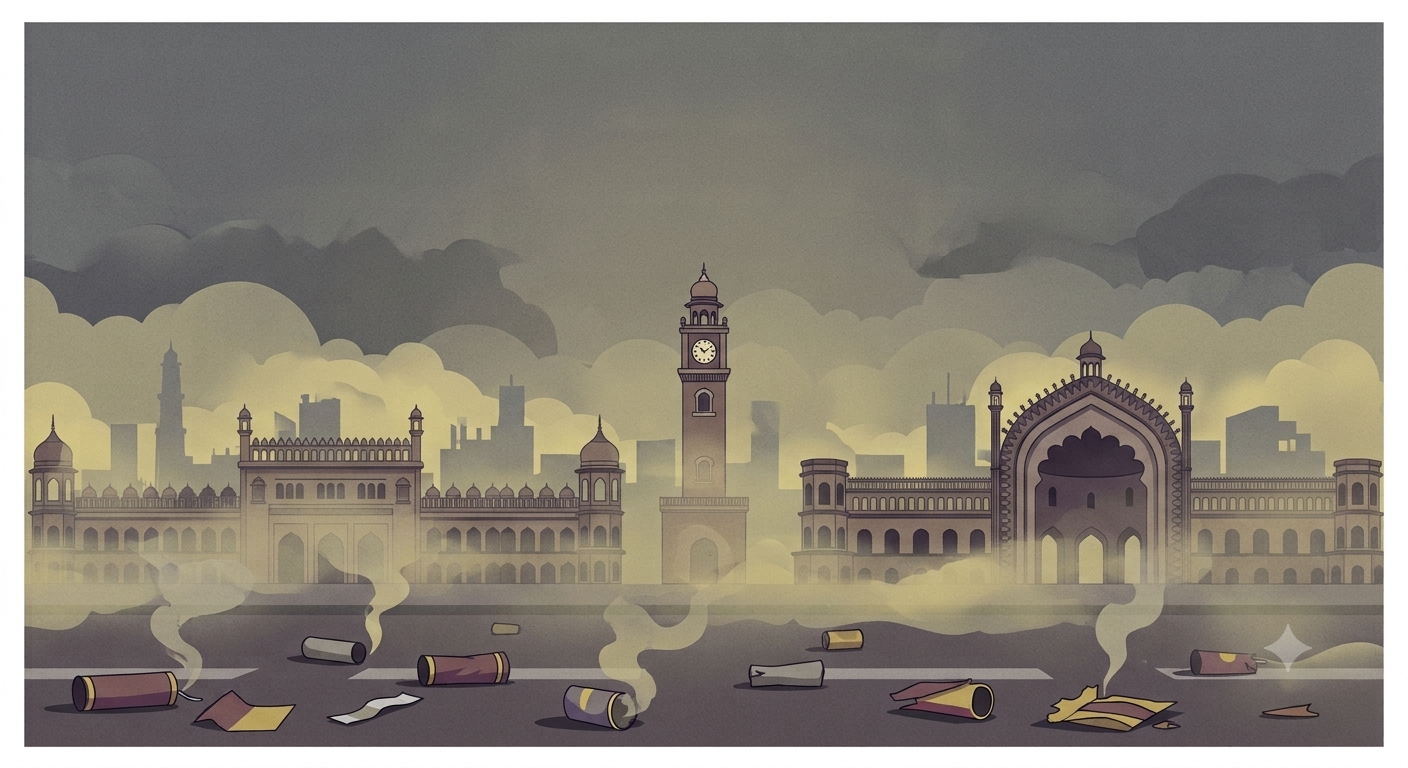
Lucknow: Air pollution levels in Lucknow witnessed a sharp spike on Diwali night, with PM2.5 concentrations increasing by 150.6 per cent and PM10 levels rising by 108.4 per cent compared to pre-Diwali night readings, according to the 2026 Diwali survey report released by the CSIR-Indian Institute of Toxicology Research (CSIR-IITR).
The report, based on ambient air quality and noise monitoring during the pre-Diwali, Diwali and post-Diwali periods in November, found that particulate matter concentrations exceeded the National Ambient Air Quality Standards (NAAQS) at all monitoring locations during the festival.
The citywide average PM10 concentration reached 726.2 micrograms per cubic metre on Diwali night, while PM2.5 averaged 400.1 micrograms per cubic metre. Both figures were substantially above the prescribed limits of 100 and 60 micrograms per cubic metre, respectively.
Aliganj recorded the highest PM10 concentration at 912 micrograms per cubic metre, followed by Chowk at 751, Aminabad at 642 and Vikas Nagar at 599 micrograms per cubic metre. Aliganj also registered the highest PM2.5 level at 558 micrograms per cubic metre.
Pollution levels showed signs of recovery after Diwali. By November 9, the average night-time PM10 concentration had declined to 300.1 micrograms per cubic metre, which the report attributed to reduced activity and improved atmospheric dispersion.

Among gaseous pollutants, nitrogen dioxide (NO2) exceeded prescribed standards, reaching an average of 113.8 micrograms per cubic metre on Diwali night, a 136.1 per cent increase over pre-Diwali levels. Sulphur dioxide (SO2), however, remained within the permissible limit, averaging 54 micrograms per cubic metre.
The survey also found widespread noise pollution. Night-time noise levels exceeded Central Pollution Control Board standards at all monitored residential and commercial locations. Vikas Nagar recorded the highest average at 90.3 decibels, while Chowk registered the lowest at 85.2 decibels.
A comparison with the previous year showed that mean PM10 and PM2.5 concentrations during Diwali 2026 increased by 28.5 per cent and 13.5 per cent, respectively. The report also noted a reversal of the declining particulate pollution trend observed between 2018 and 2022.
To control festival-related pollution, CSIR-IITR recommended strict enforcement and verification of certified green crackers, limiting firecracker use to 8 pm to 10 pm, and identifying designated open spaces away from densely populated residential areas.
It also called for immediate post-festival cleanliness drives and public awareness campaigns to reduce the environmental and health impact of firecracker emissions.




 https://www.youtube.com/watch?si=RtToJsBhYBatUrym&v=mOuYNSdhjHA&feature=youtu.be